National Oilseeds Conference: Edible Oil Security for Atmanirbhar Bharat
India is one of the world’s leading producers of oilseeds, both in terms of cultivated area and total output. The country grows nine annual oilseed field crops viz., soybean, rapeseed-mustard, groundnut, sunflower, sesame, safflower, niger, linseed, and castor besides oil palm. As perennial horticultural crop. Among these, three oilseeds crops are under major category and form the backbone of India’s edible oil supply, while sunflower, sesame, safflower, niger fall under minor group and linseed and castor serve primarily the industrial purposes. At present, India produces nearly 43 million tonnes of oilseeds annually from about 30 million hectares area, and is steadily expanding oil palm cultivation, one of the most productive oil bearing crops globally.
Despite this extensive cultivation, domestic demand for edible oils far exceeds the supply. Currently, India imports nearly 55% of its edible oil requirement, putting a major pressure on foreign exchequer, making edible oils one of the country’s largest import commodities. This persistent gap is driven by growing population with rising incomes and changing dietary patterns.
Realizing these challenges long back, India has undertaken several strategic interventions under the umbrella of ICAR to boost domestic oilseed production and reduce import dependence. Key institutional milestones include the establishment of All India Coordinated Research Project on Oilseeds, Hyderabad (1977), later elevated to the ICAR–Indian Institute of Oilseeds Research (IIOR); ICAR–Indian Institute of Groundnut Research, Junagadh (1979); National Soybean Research Institute (NSRI), Indore (1987); ICAR–Indian Institute of Rapeseed-Mustard Research, Bharatpur (1993); ICAR–Indian Institute of Oil Palm Research (IIOPR), Pedavegi (1995).
A major breakthrough came with the launch of the Technology Mission on Oilseeds (TMO) in 1986, which integrated research, production, processing, and marketing interventions to enhance productivity and move toward selfsufficiency. This led to the Yellow Revolution in the early 1990s, when India briefly approached near self-reliance in edible oils. However, gains could not be sustained, and the nation continues to strive for self-reliance in this important commodity.
In continuation to the interventions initiated under TMO, the Government of India has recently launched the National Mission on Edible Oils–Oil Palm (NMEO–OP) and National Mission on Edible Oils–Oilseeds (NMEO–Oilseeds) to significantly enhance domestic production of oilseeds and expand oil palm cultivation. These missions aim to boost productivity, strengthen market stability, and reduce the nation’s vulnerability to global supply disruptions and price volatility.
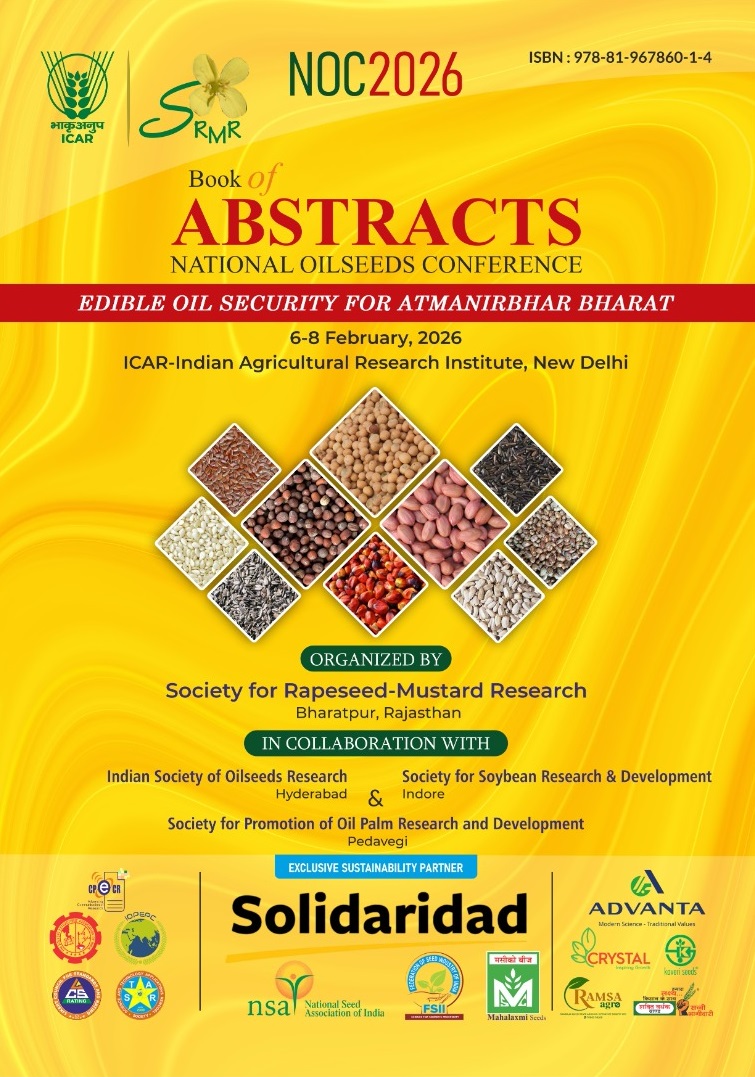
To deliberate on research and policy strategies for addressing challenges in edible oil security and achieving Atmanirbharta in oilseeds in Viksit Bharat, India’s agriculture think tank has proposed to organize, the National Oilseeds Conference on “Edible Oil Security for Atmanirbhar Bharat” at New Delhi. The conference will bring together scientists, young minds, policymakers, industry leaders, farmer organizations, and entrepreneurs to chart a roadmap for sustainable growth of the oilseed sector.
The event is being organized with the active participation of India’s premier oilseed research and extension bodies, professional societies, Non-Governmental Organizations, ICAR commodity specific research institutes, State Agricultural Universities, and allied organizations. Following detailed discussions among professional societies associated with oilseed Research & Development across ICAR institutes, it has been resolved to conduct this national event, with Society for Rapeseed Mustard taking the lead and jointly coordinating with ISOR, SSRD, SPOPRD, and other partners. The conference is scheduled to be held in New Delhi during February 6–8, 2026.
The conference aims at:
• Strengthening research and innovation in oilseed breeding, genetics, and biotechnology for developing climate-resilient, high-yielding, and high oil-content varieties.
• Emphasizing the development of varieties that are nutritionally superior for human consumption and specialty oils suitable for industries and value addition.
• Promoting sustainable crop management practices including conservation agriculture, precision farming, integrated pest and nutrient management, and efficient use of natural resources.
• Enhance post-harvest management and value addition, focusing on processing, storage, and refining.
• Encourage policy support and investment to improve seed systems, credit facilities, marketing, and public private partnerships for scaling up oilseed cultivation.
• Empowering farmers through digital outreach and technology transfer, ensuring timely access to quality inputs, scientific advisories, and market intelligence.
• Explore alternative and emerging oil sources such as rice bran, tree-borne oils, and microalgae to diversify the edible oil basket.
This national platform underscores the vision of Atmanirbhar Bharat by highlighting the importance of edible oil security as a strategic priority for food and nutritional security, economic growth, and rural livelihood enhancement. By fostering collaboration among research institutions, government agencies, industries, and farmers, the conference seeks to establish a congenial ecosystem landscape and chart a roadmap for reducing the import dependency and making India self-sufficient in edible oil sector.